Deep Blue cover reveal: I can’t wait

Here’s a great cover reveal for a new instalment in Jane O’Reilly’s Second Species trilogy – Deep Blue, the sequel to Blue Shift.

Add this blurb, and it’s yet another book I can’t wait to get my hands on!

Jinnifer Blue opens her eyes to find herself in a ship that is the source of her darkest nightmares. Her plan to expose the horrific truth behind the government’s secret Second Species programme has failed, and now she’s being turned into a weapon by her worst enemy . . . her mother.

At the other end of the galaxy Caspian Dax, ferocious space pirate and Jinn’s sometime lover, is facing an even more terrifying fate. He’s being forced to fight in the arena on Sittan, a pitiless, ruthless alien landscape where blood is the only prize that matters. They will use him, destroy him, change him.

Jinn has only one chance – to go to Sittan and find Dax before his mind is completely destroyed. She must rely on her friends and one old enemy, leave her beloved ship the Mutant behind, and travel to a hostile planet. But hardest of all, she must keep faith that when she finds Dax, there will be something left of the man she knew.

One thing’s for sure: the fight has only just begun

there’s some cool world-building here

I received my feedback from the 2017 Book Pipeline competition, in which the judges consider an extract of your novel (or your graphic novel/script/non-fiction book/book proposal) for its potential to be made into a film or TV series. For a fee, of course, but that is the usual course when you decide to put your work in front of judges for any purpose. You can see the shortlisted works here, and the finalists will be announced in a couple of weeks. My book The Pale is not shortlisted, but the exercise wasn’t a complete washout.

Book Pipeline’s extra incentive to pay an entry fee is that even if your work is not shortlisted (and therefore can’t win), you still get a paragraph of feedback.

So here is what they say: kind of yeah, no, yeah, but no.

That’s alright as I can cherry-pick the good bits (like our politicians do with ‘facts’), such as “there’s some cool world-building here”, and “classical in its approach”, and “familiar” elements “similar to Mad Max: Fury Road” (for the cyber-punk-ish bits) “and The Hunger Games” (for the competing factions aspects). I thought when I submitted that the biggest problem might be rendering the canini – my GM dogs with thumbs, enormous brains, and advanced language skills – onto film, but they didn’t get a mention.

Dystopian spaces are “incredibly saturated”, which I guess means that these folk watch the news :-). The Pale is considered just a little too classical, and too familiar, for movie purposes, but actually I think maybe that’s not a bad thing for books. Generally if readers like a book, they want to read another one that’s similar.

Anyway, it’s been an interesting and instructive process, and I now feel that I can legitimately compare The Pale to the Mad Max franchise (of which, guiltily I admit, I have never seen any), and to The Hunger Games trilogy (well, I have read the first book, but haven’t seen the movies). And “cool world-building” may well be a quote I can use for marketing.

Now, what can I pitch for the 2018 round, starting March 15th?

A Novel Kidnap

They have cut me off at the pass. They won’t leave me alone. They arrive at all hours and demand to speak to me. I feel that way too much of my life is currently in ransom to them.

And they’re not even flesh and blood!

Before you call the zombie apocalypse team or the ghostbusters, I will confess that these pesky creatures are of my own creation. When I started writing The Pale, I had no notion of how much attention these folk would claim.

My plans for February were: send Pale #2 (‘Broad Plain Darkening‘, or BPD to those in the know) to my wonderful beta readers, and give the manuscript a rest from me for a while (and vice versa). In the meantime, I aimed to spend time spruiking The Pale and attending to the thousand and plenty follow-ups. I also created quite a few questions for my beta readers to address before I embarked upon the next book in the series. I thought that their answers would help inform the action and the character development that I had loosely mapped out.

However, I planned without the consent of my characters themselves. They have insisted, and I have complied – Pale #3 has begun. Yes, it has a working title – but that’s way too embryonic for any other gaze at the minute.

Oh, and my jotted mapping of Pale #3? It may just go out the window. Character X really doesn’t want to do Z, even though it’s what I planned for him. He says he doesn’t want to head in that direction, and I have to listen to him.

Especially at 4 am.

Mapmaking, worldmaking

There are a number of fantasy mapmaking programs available free on the internet – who knew?

I’m especially fond of boing boing – where you can generate your own random fantasy world, and there are a number of others. Wonderful fun. I can (and did) spend hours exploring quite a few of them.

However, I need a map of a fantasy world which is not random, but which conforms to all the particulars I have created for it. I’m currently working on a hand-drawn draft, which is totally out of scale*, but is helping to put shape into the world of The Pale. I’ve based the coastline of the continent on various stretches of Tasmania and New Zealand, by tracing actual maps.

It’s huge fun and a big project. Once I get it into more reasonable form, I’m also going to make myself a city map for the Pale itself.

And yes, there are random fantasy city map generators out there, such as the excellent one by Geeknative.

*Just how far can a tribesman walk in one day across the hostile terrain of Broad Plain? That is the question – or one of them, at least!

A name, a name

I’m looking for a book title that’s searchable and succinct, catchy and attractive.

I realise that I didn’t do enough research when naming the first novel in my story sequence. While I checked that there were no other books called ‘The Pale’, I didn’t perform an Amazon, Goodreads, Booktopia, etc., search. Now I find that searching for The Pale brings up every book that has ‘pale’ in the title: The Pale Horseman, The Pale Rider, and so on.

So I’m being a bit more cautious about naming Pale #2.

Its current working title is ‘Broad Plain Darkening’. I like it, and a search brings up no books, but a line in a long, long poem about Napoleon – The Napolead: In Twelve Books, by Thomas Hedges Genin, published in 1833. The line (above) looks very appropriate for my purpose.

Any other ideas for a title gratefully considered!


Five tips for tackling a scary task

Halloween is over, but there are many scary tasks in store for the newbie fiction author. Today was another milestone day.

For the first time, I walked into a bookstore and said, ‘Hi, I’m a local author, and I’d like to ask if you’d consider stocking my book.’

EEEEEEK!!!!!

But I really did it. Not once, but twice. And then I added a trip into a strange libary as a bonus, suggesting that they too might like to have my *divine* work on their shelves.

Now that my pulse rate has slowed somewhat, I can share some ideas for this task:

  1. Be prepared. I kind of was. I prepared a one-page ‘Introduction to The Pale‘, on which I listed its freshly-developed tag (‘dystopian sci-fi with talking dogs!’), the link to purchase, RRP, a teaser re the characters (‘Meet the canini…’), and a short bio with contact details.
  2. Have a book to show them. I *LOVE* the cover that Michelle organised for me (thanks to Elijah Toten), and it really goes down well with prospective buyers/readers.
  3. Be prepared to give up a hard copy. Yikes! One bookshop – a very nice bookshop – said they’d love to look into it and could they have a review copy right now – so I had to say ‘Yes, of course!’ and watch the precious paper disappear behind the counter.
  4. Live your local writing scene. It helps that I sometimes go inside these bookstores, as they are in shopping strips near where I meet friends for coffee. When I made my claim to be a local author, they came back at me with other names and a degree of excitement. Lucky for me I know a couple of these people from work (at uni), so I was able to join the booksellers’ enthusiasm. But being aware of similar titles to yours, or of other local writers, seemed to ease the conversation.
  5. Populate your website. The bookstore that didn’t ask for a hard copy wanted to know if Odyssey had published a sample chapter online? I said, adlibbing quickly, not yet, but that there is a sample section about to be published on my own website.

Both bookstores said they have heard of Odyssey and would look to order after checking out the book. Fingers crossed!

The image is from Lilliput Lyrics, a children’s book published in 1899, courtesy of the free images provided by the British Library on Flickr

Image taken from page 180 of 'Lilliput Lyrics ... Edited by R. Brimley Johnson. Illustrated by Chas. Robinson'


Five learnings from the ABA conference

ABA = Australian Booksellers’ Association – a pretty important group for authors to access.

Thanks to the good offices of my lovely publisher at Odyssey Books and our dynamic distributor Novella, I was able to join the stand at the Sunday afternoon trade exhibition. This is where booksellers meet distributors and publishers. Our task was to interest booksellers (ie the folk who sell books to the reading public) in the books we had on display, so that they would consider stocking Odyssye titles (and titles from other publishers in the Novella stable).

I had a wonderful time and learnt many things about the book trade and about book folk. Here are  five major learnings that could change the way you approach marketing and self-promotion:

1. It’s hard to give away books

Even though all the sample books were free, it is quite difficult to persuade a bookseller that they need to add any specific 500g of brilliance to their luggage for the flight home. They have to be convinced that it’s worth their while. I hadn’t expected this – I mean, put me in a room full of free books and I’ll pay excess baggage any time!

2. About giveaways and gimmicks…

Some of the stands offered all manner of freebies, including champagne, chocolates, cupcakes, pens, notepads, neck massages and canvas bags. The neck massage included a chance to sample an e-book on an iPad. My impression is that the stands with canvas bags gave away most sample books, especially at the start, because folk could put the books in the bag. I wasn’t sure that the other giveaways resulted in more books being taken – but they certainly helped to stop the traffic so that booksellers actually looked at the stand.

3. Being an author counts

I had the best success when I was able to tell the person I had waylaid that the book I was offering had been written by ME (pointing to cover and to name tag so the connection could be made…). Booksellers appeared to be impressed by the fact that I actually had written a book that was being published! Congratulations flowed (more so than the champagne). Giving away review copies of my own soon-to-be-published book was comparatively easy, and indicating that I would be (more than!) happy to visit book stores to do readings/signings created a warm glow that I will definitely follow up 🙂

Being there to sign the actual book also worked for another Novella author who was present, Harrison Craig whose book Harrison’s Song has just been published by Wombat.

4. Folk won’t wait

At other events, I have also experienced this conundrum – either there’s nobody at your stand and you look sad, or else your stand is crowded with people and other potential contacts walk away without a backward glance. This is inevitable at such an occasion, but I wished for an easy (and light-weight) take-away for such people, along the lines of those tear-off contact details you see pinned to notice boards.

5. Books ARE judged by their covers

It’s quite true. Not saying that good books might not dwell inside dodgy covers, but it was definitely the cover art that made folk look at my book. (PS I love the cover art!) Another cover that drew interest on the day was for the children’s book The Whirlpool by Emily Larkin, also published by Wombat. High quality, attractive images that clearly indicate the book’s genre seem to be the way to go.

6. Bonus learning: say YES

OK, I said five learnings, but here’s number six: whenever you are offered a chance to spruik your book, do it! You and your manuscript have already survived the seas of rejection and heartache, so what does it matter if some people think your book is not worth its weight in their suitcases? Someone else will tell you they love the look of it – and just one of those comments is worth any number of ‘no thanks’-es!

Lost arts of the twentieth century: the rendezvous

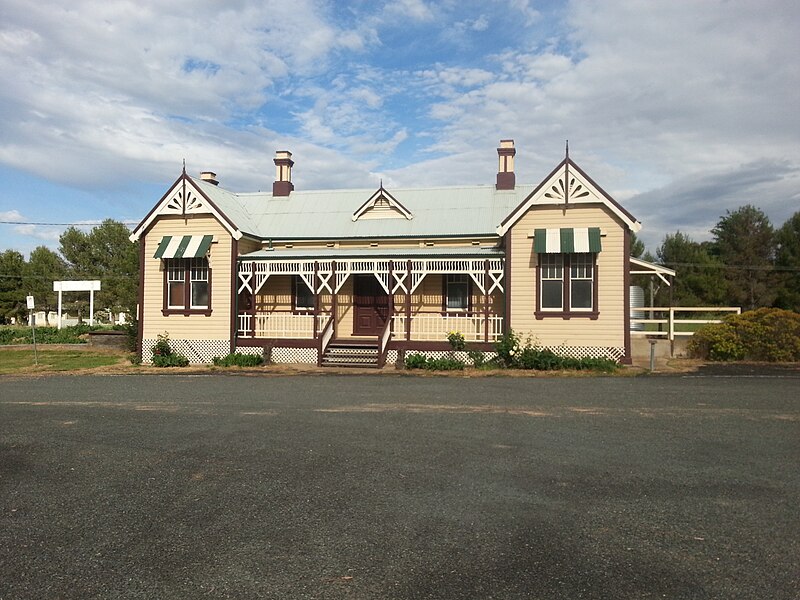
Back in the day, there were meeting places where you waited for your family or friends to come find you. Under the clock at the railway station, in front of the department store window (yes, ‘window’ singular), at the corner of the school. Eventually, Dad would come to drive you home from the station, or your friends would show up for your shopping expedition, or your little brothers would mooch up to be walked home.

File:Grenfell, NSW - Railway Station 1.jpg

No mobile phones, so no texts or emails or either, to let you know someone was late, or that they weren’t coming. I guess waiting is a bit of a lost art too. No phone to look at while you stood at the meeting place. (Of course, I always had a book at hand. Always.)

Meetings could be the highlight of your day, or your biggest disappointment. Being stood up by that cute guy I met at school dancing class, who promised to meet me at the bus stop the next week. Such an embarrassing and gauche moment!

On the plus side, at least he didn’t text me saying it was him, not me…

Notions like this complicate the writing process. It can be quite difficult to get into that space, that space where your characters don’t know what’s happening elsewhere, and can’t easily find out. Mind you, writing about the twentieth century is Historical Fiction after all. As a writer, having inhabited a previous era is no guarantee of being able to write it convincingly.

Ah well, back to the typewriter I guess…

Photo: Grenfell Station by Geez-oz from Wikimedia Commons https://commons.wikimedia.org/wiki/File:Grenfell,_NSW_-_Railway_Station_1.jpg

In the city

I just pushed my way in.

That’s the first sentence I heard as I strode across the bridge over the Yarra on my way to a watercolour class. I’ve read about a writing exercise where you put together randomly heard phrases and create a story.

I just pushed my way in.

You can’t wear that.

Are you happy now? She’s crying.

Fifteen.

No, the next one.

wood.jpg

Maybe it’s a poem, or a flash fiction. I liked the words so much I almost walked against the traffic lights. I tried not to see the speakers. I’m imagining how those words would sound, how they would carry meaning, in different settings. When they are not on the bridge over the Yarra.

How would they sound in a snow-bound forest? On an ocean liner? On top of a mountain? In a derelict house? Outside the classroom? In the foyer of a bank? At the kitchen table? In a cafe? At the beach? On a train? In a waiting room? In the Tardis? While Vesuvius is erupting? At the Queen’s coronation? In a container full of refugees?

Perennial problem. Too many stories to tell. Stacked like logs in a pile. Which one to choose? I can’t tell them all 🙁


Living as if

OLYMPUS DIGITAL CAMERA
Year of the Rooster

This year has started with a great burst of energy. I’m trying to keep momentum going as I strive to inhabit the life I want to lead – the life of a writer. I’m a bit afraid that if I pause for more than a few minutes, I’ll lose all impetus. So I just keep going.

It strikes me that while it is quite difficult to imagine oneself as a writer, it is even more difficult to describe oneself as a writer. Do I deserve the name? Am I sufficiently writerly in my habits? Do I produce enough words on the page? How much do I need in the way of publications before I can call myself a writer? As for income! That would be a very high criterion indeed.

But I know that I am never more content than when I am lost in writing, when the words dash along onto the screen, all un-edited and mis-typed, and *my* characters face the lives they’ve been dealt. They *live* almost as if they are alive …

Maybe that’s all we can do. In this year of yes, let me live as if I am a writer.