
Rosalie Ham: author and extra

Rosalie Ham Australian author

Rosalie Ham is an Australian author most famous for her debut novel The Dressmaker, a black satire about love, payback, and 1950s haute couture, which was made into a major motion picture starring Kate Winslet, Judy Davis, Liam Hemsworth, and Hugo Weaving in 2015.

Recently I was fortunate enough to meet Rosalie at an event where she explained how the movie was made, her part in it, and the challenges of shifting a story from prose to film. Rosalie was so inspiring that, grabbing my courage in both hands and telling myself that being scared every now and then is good for me, I introduced myself and asked if she would consider appearing on the Last Word of the Week blog. And here she is! 
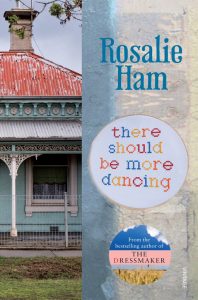
There-Should-Be-More-Dancing-677x1024

Thank you for joining me today, Rosalie. Can you tell us something about yourself that you think anyone who reads your book/s really ought to know?

Rosalie: I tend towards the ironic, and so some readers don’t ‘get’ that sort of tone or my black humour, but I get that not every book is for every reader.

That’s a great way to think about it, very wise. What is your favourite scene from your own writing? Why?

I have favourite scenes in all four novels, so I’ll pick a couple. In The Dressmaker it’s at the end when Sergeant Farrat is sitting on top of The Hill. Everything around him is razed, the landscape burned flat to the ground, smouldering and smoking, cinders floating. The District Inspector of Police arrives and asks, ‘What happened?’

The sergeant replies, ‘There’s been a fire.’

Summer-at-Mount-Hope-677x1024

At the beginning of Summer at Mount Hope Phoeba, Lilith and Maude are sitting on the narrow bench of the family sulky which is stranded in the middle of a roadside dam. The three 19thcentury ladies are wearing their Sunday best, sheltering from the sun under their vast, ostrich plumed hats. Their skirts are bunched on their laps exposing the lacy trim on their bloomers, their boots are up on the dash, slimy green water swirls just below their bottoms and the tail of the horse supposedly conveying them to Church floats before them. In the quiet of the country lane, they hear a carriage approach. It is the grand Britzka containing the wealthy neighbours from the vast property to the west. Maude speculates, ‘They may not notice us.’

Oooh, yes, these are perfect. From what I have read, I understand that your characters are not completely imaginary, but based on real people. Has anyone recognised themselves in your books?

I suspect most writers create characters using elements of real people. Because characters, basically, carry a theme, creating a plausible vehicle is my main focus. The added personality traits are instilled to make them more memorable and hopefully readers might then find empathy with a character and his or her purpose. Some readers out there might just recognise why a character says and does certain things.

I know that you appeared in the film version of The Dressmaker as an extra. Are you a character in any of your books? Why/why not?

No, I’m not a character in any of my books. Generally, in order to create an effective character for a particular role that character needs to do what you want them to do. Their intention is their narrative drive, if you like, so their intention has to be quite separate to what I might say and do. It’s essential to strive to present a balanced argument, so you need to think about alternate arguments and create characters to present them so they all need to be other than the writer’s personal point of view. The story becomes about the argument rather than how I feel about the point I’m prosecuting. 

Dressmakermovieposter

That makes sense. Take yourself back ten years – what would that Rosalie like to tell you?

Trust your ability. Believe in yourself more, go for it, your stories will reach further than you imagine.

Amazing, yes. What’s next for you in the world of writing?

 More writing. I’ve got a few more events to attend this year to promote my last novel, The Year of the Farmer, then there’s a rough first draft of my fifth book that I’m dying to get stuck into. As I see it, there are at least two more novels I could write. And I have a dream that one day I’ll adapt one of my novels to a stage play. And I need to do all of this while teaching part time.


Year-of-the-Farmer-677x1024What’s the single most important quality in a writer, in your opinion?

Talent. Some books are written through sheer determination and they’re good. Readers will get much from them, but some writers are different, their stories boil straight from the heart, they burn and shimmer, they’re well-structured and moving, revelatory, unique, life-changing, and above all, memorable. That sort of writing can’t be taught, it comes from the way writers look at the world and convey it to others.

And finally:Who would you be if you were a fictional character – one of yours, or someone else’s?

I’d be Phoeba Crupp from my second novel, Summer at Mount Hope. I’d grow my own grapes and produce fine wine, raise beautiful sheep with superior wool, cultivate exceptional grain crops and work hard with nature. Because I value friendship above romance, I’d carry sad matters of the heart in my back pocket like a spare hanky. When my father betrays me, I’ll turn that to my advantage and make my life a testament to female strength and the fighting rural spirit.

She sounds divine. Great choice.

Thank you so much for sharing with me today, Rosalie. I was indeed a pleasure and an inspiration to meet you.


Rosalie’s Links:

Website: https://rosalieham.com/

Twitter: @RosalieEHam

Facebook: https://www.facebook.com/RosalieHam/

If you’d like to book Rosalie to talk at your school, library or book club (or fundraiser, lunch, valedictory…) please get in touch with Booked Out Speakers, Melbourne on (03) 9824 0177. I can highly recommend her as a speaker!

Rosalie is represented by Jenny Darling and Associates (03) 9696 7750

Nicola Pryce sails to Cornwall in 1773

Nicola Pryce writes romances featuring Cornwall, adventure, drama, handsome heroes,  and foregrounding remarkable women – an irresistible combination. If you’re a bit keen on Winston Graham’s Ross Poldark, or Jane Austen’s Captain Wentworth, or any well-written historical fiction, then you need to meet Nicola asap. Not in 1773. Now!

*Plus read on for a bonus scene!*

Welcome, Nicola. It’s great to meet you. Can you tell us something about yourself that you think anyone who reads your book/s really ought to know?

Nicola: If I have to reveal secrets, then it’s that I sail, certainly, but not across vast oceans. I’m more of a harbour hopper, sailing in and out of the towns and secret coves in Cornwall that I describe in my books. My characters inhabit my world, only 226 years before me. I follow their footsteps – every mile they walk, I walk; I have been to every harbour they anchor in, every river they row up, and every inn they dine in. Every mad dash they make across Bodmin Moor, I’m racing behind them. The houses they live in are all there, the streets they walk, the moonlit rose gardens and clifftops where they meet. And I wake to the same hammering in the shipyard, the same bleating of the sheep, the same crowing of the cockerel.

That’s great to know! What is your favourite scene from your own writing? Why?

My favourite scene is in The Captain’s Girl. My aristocratic heroine, Celia Cavendish, finds herself on a fast cutter in the charge of the rather secretive Captain Arnaud Lefèvre. It is two in the morning, the wind is gentle, the stars bright above them. Captain Lefèvre serves freshly caught seabass, grilled on a bed of herbs; they drink Chablis, watch a shooting star, and all the while the south coast of Cornwall is drawing closer. As she breathes the salt air, relishing the wind in her hair, Celia feels free for the first time in her life. At daybreak, she must return to rigid protocol and social niceties, but more importantly, she must explain her sudden absence.

Oooh, how intriguing! If I told one of your characters (you get to choose which one) that they were imaginary, how would they respond?

Badly!  I could see it hadn’t gone well when I saw Madame Merrick staring down at me from the first floor of her dressmaking establishment above Pengelly’s Shipyard. The sun was glinting on her lorgnettes and knew that as soon as I opened the door, her hawk-like eyes would pin me into submission.

And I was right. Her silk petticoats rustled as she swung to face me. Elowyn and Mrs Pengelly took refuge in the storeroom, but I knew I must stand my ground.

‘A figment of your imagination? Her French accent is always more noticeable when she’s cross. ‘I think not!’

I had to be brave. Most would turn and run, but I had to explain.

‘You’re a character in my stories, Madame Merrick. You don’t exist off the pages of my books.’

A rise in her perfectly arched eyebrows, a slight ruffle in the feathers of her headdress, and then a smile – and it’s always worrying when Madam Merrick smiles.

‘Well, perhaps it is not such  a bad thing. Maybe it is better they think you have fabricated my existence. Yes, let them think that – let them believe, I do not exist. It might well work in my favour. Will you take a glass of punch with me?’

I had to say I would, but only a small glass as I know only too well what goes into Madam Merrick’s punch.

Oh, that’s marvellous, Nicki, thank you so much! An extra scene. Yippee!

4

Can you think of any books and/or writers who inspired you on your path to be an author? Can you tell us about that? 

I was a dreamy child, a boarder from the age of eight in a school with limited television and a large library and I spent rather more time reading than I should  – even finishing Gone with The Wind by Margaret Mitchell in orchestra practice with tears rolling down my cheeks!

I read everything I could, from Agatha Christie detective novels to John Wyndham’s science fiction, but mainly I read historical fiction. I loved Jean Plaidy, Anya Seton, Elizabeth Goudge, Georgette Heyer, Huge Walpole, R F Delderfield, as well as all the Angelique books which we had to cover in brown paper! I did English A level and I enjoyed discovering the Classics.

At 42, I completed an Open University degree and found myself drawn to the eighteenth century and that has certainly influenced the books I write. My favourite author is Jane Austen, but it was Daphne du Maurier and Winston Graham who introduced me to Cornwall through their books.

The Rebecca and Poldark effect, eh? Perfect. Take yourself back ten years – what would you like to tell yourself?

I left school at 18 telling everyone I was going to write a historical novel, but my nursing career and my three children took up all of my time.

Ten years ago, at 52, I decided my children needed to know the real me. They knew me as their mother, and a nurse, but they didn’t know the stories that were always in my mind. I had never written anything down, but I decided to return to the child I was, to the incurable romantic who had read her way through school. So I began writing my first novel – Pengelly’s DaughterIt took me three years. I had never written anything before, but it was picked up by an agent, and then Corvus Books wanted a second book, and a third and a fourth.

What would I say to my myself ten years ago? I’d say, ‘Sit down, take a deep breath because you’re NEVER going to believe this …!’

Indeed, what a fabulous story. Good for you! What’s next for you in the world of writing?

I’m currently writing the fifth book in my series. Each book is written through the eyes of a different heroine. You get to know the new heroine in the previous books and so Book 5 follows The Cornish Lady. It’s now 1799 and Amelia Carew is facing a terrible dilemma.

boat photo 2

You can follow the order on my website http://nicolapryce.co.uk/  but all my stories can be read as stand-alone books. I put photos to illustrate the history behind my stories on my website, so there’s background information as well.

Uh-oh, that’s a few more for my TBR pile – but thank you so much, these sound wonderful. And finally: Who would you be if you were a fictional character – one of yours, or someone else’s?

This is such a difficult question because, let’s face it, the trouble with books is that you get to fall in love with so many heroines as well as heroes. I would, of course, love to be Elizabeth Bennet, but – and I might regret this – I think I’m going to go for the daring-do, the energy and romance, and the sheer glamour of Marguerite St Just.

I’d like to be beautiful, graceful, witty, highly intelligent and I’d get to go to fabulous balls and wear stunning silk gowns. I’d have the whole of London falling at my feet, and I’d speak fluent French. I’d also have the very good fortune of discovering that the man I loved, and who had disappointed me so very terribly, is none other than the divine Scarlet Pimpernel.

I’d be just as cross with Sir Percy, just as hurt and disappointed; just as petrified of Citizen Chauvelin, and just as desperate to save my brother. But I’d be her, so I’d have her courage – her extraordinary bravery as she sets off across the channel to save her husband.  Yes, can I be her, please? The Scarlet Pimpernel by Baroness Orczy.

Thank you so much Clare for inviting me to share your Last Word of the Week. I’ve had a lovely time answering your questions.

Thank you Nicola, you’ve been a great guest and I’d love to talk again – how about when Cornish Saga 5 appears?! In the meantime, of course Baroness Orczy would love to host you in her novel :-).

Nicola’s Links

Website     http://nicolapryce.co.uk/

Facebook  https://www.facebook.com/nicolaprycebooks/

Twitter      https://twitter.com/npryce_author

Instagram https://www.instagram.com/nicola_pryce_author/

Amazon      https://www.amazon.co.uk/Cornish-Lady-Saga/dp/1786493853

Kobo             https://www.kobo.com/at/en/ebook/pengelly-s-daughter

Barnes and Noble    https://www.barnesandnoble.com/w/the-cornish- dressmaker-nicola-pryce/1126737521

Marianne Holmes and family secrets

A_LITTLE_BIRD_TOLD_ME by Marianne Holmes

Marianne Holmes’ debut novel A Little Bird Told Me is a great read that pulls you in and keeps you guessing – see my review from earlier in the year. I’m rapt to have Marianne answer some ticklish questions on this edition of Last Word of the Week.

Welcome to Last Word of the Week, Marianne!

 Marianne: Thanks so much for having me, Clare, and congratulations on the publication of The Ruined Land.

Thank you! It’s very exciting, but let’s talk about you today (or this post will be VERY long!). Can you tell us something about yourself that you think anyone who reads your book really ought to know?

Ooh, that’s a hard one, I’m not sure readers need to know anything about me at all! However, part of A Little Bird Told Me is set during the British heatwave of 1976 when I was the same age as my main character, Robyn. I have a particularly strong memory of that summer because my family moved back to the UK after a couple of years in Germany. We found huge cracks had appeared in our lawn, the tarmac on the roads melted and there were ladybirds everywhere. The hot weather was wonderful for us kids but did make everyday life harder for the adults.

marianneholmesrmay18-12-0409s 3843x2745px

We also owned a TV for the first time and I remember suddenly being exposed to pop music, kids’ programmes and lots of American shows and films. It was quite a revelation!

That probably explains the great sense of setting in your novel – you were almost there! What is your favourite scene from your own writing? Why?

There’s a scene early in A Little Bird Told Me that happens after the nine-year-old Robyn is given a gift by a stranger.  She’s too tired to tell her mother about it that night and instead asks for her favourite bedtime story about how the family came to live in their home. The story is so familiar to Robyn that she joins in with the telling of it.

I love the way families create these little narratives about who they are and how soothing children find this kind of repetition. In the story, it’s a nice little moment before Robyn starts learning the truth behind her mother’s tale.

A Little BirdYes, that’s a great family insight. If I told one of your characters (you get to choose which one) that they were imaginary, how would they respond?

I think the child Robyn would be fascinated but adult Robyn would be a mix of furious and resentful. At the beginning of the story, she’s trapped by the events of her past and if she discovered that none of that was real I can see a fair bit of foot stomping.

Oh yes, I can see that! Can you think of any books and/or writers who inspired you on your path to be an author? Can you tell us about that?

This is such a difficult one and changes every day. I love The Secret History by Donna Tartt, All The Pretty Horses by Cormac McCarthy, A Song for Issy Bradley by Carys Bray, Cloud Atlas by David Mitchell and anything by Iain Banks, Umberto Eco, Kate Atkinson, Margaret Atwood… I could go on for pages!

My favourite reads over the summer have been Circe by Madeline Miller and The Silence of the Girls by Pat Barker. I have always had a soft spot for myths and legends but these new retellings from a female perspective combine fantastic writing and innovation and that’s inspirational. 

I agree entirely. Some great tips there, thank you! Now, take yourself back ten years – what would you like to tell yourself?

Ten years ago, I had a super active toddler and was coming to terms with a second miscarriage and the death of my Dad. I was pretty exhausted, feeling guilty that I wasn’t like those other mums that set up new businesses in the evening after the baby’s in bed. The thought of writing a book was a very distant dream indeed.

So, I’d tell myself, and anyone else in similar circumstances, to try and worry a little less, be kind to yourself when you need it and enjoy the small moments. A year later I was pregnant with my second child, which was wonderful and unexpected, and my oldest was starting at playgroup. It was that extra time at home with the baby that allowed me the space to think about writing. 

So much can change in ten years, can’t it? Kindness is essential, especially to yourself at such times. What’s next for you in the world of writing?

I’m editing another novel at the moment or will be just as soon as the kids are back at school this week. It’s about a young woman who, partly out of loneliness and partly because of her own history, is drawn into the public outpouring of concern and grief surrounding the case of a missing child. Her involvement leads to a series of deceptions that carry her deeper and deeper into trouble. 

Oooh, that sounds interesting! Do let us know when it gets to print. And finally: Who would you be if you were a fictional character – one of yours, or someone else’s?

Hmm, I’m not sure whether I should be answering with a character that I think is most like me or a character that I would most like to be. That would make quite a big difference!

Reading Circe right in the middle of school summer holidays this year, I found a passage where she discovers that the island she’s been exiled to is quite beautiful, has all the wildlife she needs to pursue her sorcery and, to top it off, her home is self-cleaning and her food replenished fresh every day. I had a very strong urge to be Circe in that moment!

Excellent answer! Thanks so much, Marianne, for sharing with me on Last Word of the Week.

Marianne’s links:

Twitter @MarianneHAuthor

Instagram @MarianneHAuthor

Website www.marianne.holmes@talk21.com

A Little Bird Told Me: https://www.amazon.co.uk/Little-Bird-Told-Me-ourselves-ebook/dp/B07FB4D86F


Gill Thompson and her joined-up writing

The Oceans Between Us by Gill Thompson cover

Today I’m speaking with Gill Thompson. Gill has spent most of her career lecturing in English at sixth form level, but her hankering to write fiction has never gone away. She enrolled in and completed a Masters in Creative Writing at the University of Chichester, and says it was the best thing she ever did.

Gill understands both ends of the writing process: the planning and editing required to produce a text, and the reading and analysis it takes to appreciate it. She says she is now finally fully joined up! The writers among you will find her website full of wonderful writing tips, and the readers will be very interested in her wonderful historical novel The Oceans Between Us about the post-WWII child migrant process. So relevant in today’s context of the movement of people seeking refuge and safety, and with a foot firmly in both the UK’s and Australian social history.

The Oceans Between Us cover image
The Oceans Between Us by Gill Thompson

Welcome to Last Word of the Week, Gill! It’s lovely to have you. Can you tell us something about yourself that you think anyone who reads your book/s really ought to know?

That’s a difficult one! My book is about a child migrant from Britain to Australia just after World War Two. I don’t have any personal connections with that story (I’m old, but not that old!) – and in fact I agonised for quite some time about whether it was my place to tell it – but the support I received from ex migrants, and from The Child Migrants Trust, the charity that reunites parents and children, gave me the encouragement to go ahead. The fact that many people have written in their reviews of the book that they are grateful to have found out about this event makes me feel I’ve done the right thing.

My only common ground with the novel is that it is about a mother separated from her son. A few years ago, our son set off on what we now call his ‘gap decade’ (!) as he found a way to combine work and travelling. He is now settled in Bucharest where he met the girl of his dreams and they are getting married next month. I am happy for him, but I know how my character Molly feels at being separated from her child. It’s really hard! I certainly think I wrote those scenes from the heart.

Separation, especially for an unknown time, is really hard! What is your favourite scene from your own writing? Why?

I submitted three chapters from the novel as my dissertation for the Creative Writing M.A I undertook in order to help me write the best book possible. I remember describing a scene from that section that I was particularly proud of to my husband. Instead of giving me the approval I desired, he pointed out that I had missed an essential part of the plot. We argued about it for ages. I went away and sulked, then reluctantly conceded he had a point and finally, begrudgingly, I  rewrote it. To this day, that scene, which features my protagonist Molly acknowledging that her son Jack must have died in the bomb blast that destroyed their home, is one of my favourites. It was clearly right to put it in. I’m not going to tell my husband that though!

Oooh, a marital secret, how exciting :-). If I told one of your characters (you get to choose which one) that they were imaginary, how would they respond?

What an interesting question! (Don’t people always say that when they don’t know the answer?!) I think it would have to be an indigenous Australian girl called Rosie. Whilst I was researching the story of the child migrants, many of whom were falsely told they were orphans in order to lure them to Australia, I came across an eerily parallel account of the ‘Stolen Generation.’ These were Aboriginal children, taken from their parents as part of the White Australia policy. In my story, Jack and Rosie meet and bond through their common experience of loss. Having seen Timberlake Wertenbaker’s play Our Country’s Good, (based on the Thomas Keneally novel of the same name) and read Bruce Chatwin’s The Songlines, I’d become fascinated by the rich spiritual life of indigenous Australians, particularly their belief in the power and role of dreams. I’ve tried to convey this through my characterisation of Rosie who sometimes has supernatural insights. Of all my characters I think she would have understood the slender line between reality and fantasy and wouldn’t feel threatened by being told she was fictitious.

That’s a really great answer – and it actually makes Rosie more real to me! But more about you: can you think of any books and/or writers who inspired you on your path to be an author? Can you tell us about that?

I love the novels of the late Helen Dunmore. She had such skill at writing compelling human stories against the backdrop of historical events. I wouldn’t place myself in the same league as her but she is definitely a big influence. I read quite a lot of Tim Winton’s books when I was researching my story as I think he conveys the landscape and atmosphere of Western Australia so well. My central character, Molly, loses her memory so I read a few stories about memory loss such as ‘Pieces of Light’ by Charles Fernyhough and ‘Briefing for a Descent into Hell’ by Doris Lessing. I also love Maggie O’Farrell’s dexterity with words and the way she gets inside people’s minds so convincingly. Finally, Anne Tyler has an amazing ability to convey huge life issues within seemingly inconsequential events. I can only dream about writing as well as any of these authors, but they have certainly given me something to aspire to.

Ah, we have a lot of reading tastes in common! Lovely. Now, take yourself back ten years – what would you like to tell yourself?

Ten years ago my parents had both recently died and my husband was in the middle of a decade of ill health which he was seemingly unable to recover from and which doctors were baffled by. I was trying to care for him whilst supporting our family with my job as a teacher. I’d wanted to write since I was very young but life always got in the way. My father had written text books on Photography but always had a secret ambition to write a novel. I think he passed that on to me! Although he died in 2001, I was able to enrol on my Creative Writing M.A with some of the money he left me. It was hard at times, with Paul so ill, but I managed to scrape through it, and my novel ‘The Oceans Between Us’ started to evolve.

Eventually Paul recovered and I had the space to give the manuscript more of my attention. It took me nine years before it was published but I am so glad I stuck at it. I often wish I could travel back to 2009, when life felt so bleak, and tell my former self that my dream of writing a novel really would come true, and that life really would get better. I wish my father had known how my writing aspirations would end up.

That’s a great story, and I have some similar experiences and feelings. What’s next for you in the world of writing?

I have now written a second novel, ‘The Child on Platform One,’ about a mother and daughter separated by war, which comes out next March. It’s gone through two rounds of edits so I just have the proof reading to do and then it’s finished. To be honest, I don’t have a single idea for book three at the moment. I think the creative well has run dry! I am going to give myself the summer off. We have our son’s wedding to prepare for and my daughter and her husband are having an extension built so I have a feeling they will be bringing our two adorable granddaughters to stay with us on and off through July and August so I will have plenty to keep me busy. I am hoping inspiration will strike by the autumn though so that I can get writing again. I think I would miss it if I didn’t.

Oh, yes, I do hope there’s more to come! And finally: Who would you be if you were a fictional character – one of yours, or someone else’s?

I am currently obsessed by Eva, the protagonist of my second novel. She is a musical prodigy living in Prague during the late 1930’s. Later, when she is taken into a concentration camp, she uses her musical talents to mount a defence against the Nazis. I don’t have a musical bone in my body but I am fascinated by the power of creativity to triumph over adversity.

What a great creation, and a good choice. Thank you so much Gill for sharing with me today on Last Word of the Week.

Gill’s important links:

Website: http://www.wordkindling.co.uk

Twitter: @wordkindling

Spoodle Wolf – writers and their dogs

Aeryn the spoodle-wolf writing companion

Dogs rock.

I love them and their big hearts. That’s why they feature so much in my writing (like my beloved Mashtuk in the Pale series).

I’m keen to get hold of a new book to be released next month – The Wisdom of Wolves by Elli H. Radinger. It looks fascinating. The byline is ‘what wolves can teach us about being human.’ We certainly need that!

This is a recent picture of my writing companion Aeryn. When she thinks I’ve done enough at the keyboard, she stands up and puts both front paws in my lap.

I’m sure my patronus is the wolf – what’s yours?

Newsletter coming soon!

The Pale cover

Fabulous news! In 2019, I’ll be starting my very own newsletter – a monthly digest of interviews, book reviews, event notices and flash fiction. Stay tuned for more information!

desk-terminplanung-control-newsletter-163066.jpeg
Photo by Pixabay on Pexels.com

I’ll be looking for contributors too. If you have some short-short fiction that would like an airing, keep an eye open for my submission process.

storm flash
Photo by Martinus on Pexels.com

This is SO exciting! I can’t wait to get started.

Happy New Year everyone! See you in 2019.

Seven carry-on travel must-haves

Packing for long-haul flights has become quite a regular task for me. That’s what happens when you live in Australia and love so many things in the northern hemisphere! Real winter! Fjords! Paris! The British Museum! The Acropolis! … I won’t go on.

Here I’d like to share my list of 10 must-haves for long journeys, with links to my particular favourites. Plane, train, ship – these accessories will make the travel easier!

  1. Books. I really cannot go anywhere without a book. Without a few books. For me, some will be on devices, others will be in hard copy. It’s hard to go past Odyssey Books for something with adventure, intelligence and style!

    Puzzle/colouring in book. Ditto – I get twitchy if I’m out of range of my pencils and pens. I’m not addicted to sudoku or anything in particular, but I love a good crossword and an interesting picture to colour in.


    Writing implements. Pens, pencils, little book, laptop, USB. I must write, pretty much everyday.

  2. Hand lotion. Have you ever noticed how much thinking happens when you rub perfumed cream into your skin? It’s very restful and allows your imagination to dance.

    Noise-cancelling headphones. Expensive, I know, but these are wonderful. They completely cut out the horrid white noise of the plane and allow you to focus on the movie or music of your choice. Travel is very different since I found these!

  3. Flat shoes. I usually take an extra pair of shoes in my hand luggage. Then, depending on which way I’m travelling (keeping in mind that when I’m swapping between hemispheres, I’m also swapping seasons). So I might get on wearing boots and change into flats for the trip, or wear flats for the trip and change into boots on arrival.
  4. Scarf/shawl. See #6. I’m often changing seasons in one flight, and then of course there’s the complete mystery of air-conditioning. Too hot, too cold? Your scarf/shawl will do the trick.

Last Word of the Week: Jeannie Wycherley

Blessed with a wildly overactive imagination, English author Jeannie Wycherley is chatting with me today. Jeannie lives in Devon with her husband and the fur-kids, three beloved dogs who are spoilt rotten (something I totally understand). Jeannie writes stories that are dark, suspenseful, horror-filled … and sometimes just plain weird in a wonderful kind of way.

32765394_10157146128684897_830847262904025088_n

LWOTW: It’s so lovely to meet you, Jeannie! Tell us, when did you write your first story?

Jeannie: I suppose like most writers I began in school. I loved writing, but you know what careers officers are like. They put me off. Instead I followed an academic path – right through to a PhD in history (which I loved doing, don’t get me wrong) – and worked in education for a long time. I ended up burnt out, on anti-depressants and receiving counselling for my struggle with work. Turned out I was just doing the wrong job and needed something more creative.

I started to write again in my early-forties and fell in love with it. It’s a rare day indeed where I don’t now do something related to my writing. My first success was an erotic story entered into a competition. I forget what it was called but it won. I was hooked!

Thanks, Jeannie, that really is a marvellous story and a bit of a reminder to those of us who have put off writing to do something more mainstream! What do you think of dreams, imagination, and planning?

Where would we be without any of those things? For as long as I can remember I have lived inside my imagination, a rich and colourful tapestry of weirdness for sure. I dwell there, with the characters I meet in other people’s work and the ones I conjure up myself. On long journeys I settle down for a good day-dream and put those characters in my head to work in different situations. My mind is a magical place, preferable to day-to-day reality sometimes!

Dreams are extremely important on a number of levels. I have my own dreams, as in my ambitions, driving me forward as a writer. I would love more people to delve into my stories. I’m sure there’s something for everyone. My ultimate dream is to write full time and support myself and my husband through sales, but at the moment it’s a balancing act.

I use my own nocturnal dreams as a starting point for stories. I recently wrote a love story (my first one as I usually write dark fantasy and horror) that came straight out of a dream. I awoke having experienced this coherent exploration of my feelings towards growing older, and feeling regret about things I miss from my younger years – a youthful body, the excitement of music and life and dancing, the first flush of true love etc. I really badly needed to write this up, and it became Keepers of the Flame. It’s a story I’m proud of, although a huge step away from what I normally write.

32792474_10157146132574897_6428830013566484480_n

As for planning, well … I am a planner, and all my work is plotted. I find it makes writing easier, although there is room for manoeuvre within the story if things strike me of course. Sometimes characters – and events – can take me completely by surprise. I love it when that happens.

Yes, that’s brilliant, isn’t it? What’s the highlight of your writing career so far?

At the time of writing, the highlight is probably the publication of my debut novel Crone (2017). Sometimes I flip through my own copy and I think, ‘Did I really write that?’ Hahaha! It’s won a few awards that I’m proud of. A Chill with a Book Readers’ Award, and an Indie B.R.A.G Medallion.

32624224_10157146131739897_893156625504796672_n

But by the time this piece goes out, it will definitely be The Municipality of Lost Souls. The characters and the setting have me totally hooked and I can’t wait to unleash it. It’s a Victorian Gothic ghost story set where I live on the East Devon (UK) coast – think Jamaica Inn meets The Walking Dead but with ghosts rather than zombies. It’s special and due out in Spring 2019.

Jamaica Inn meets The Walking Dead? Now I’m scared! Congrats on the new publications too. What are you most busy with at the moment?

I am hugely busy! I’ve just launched a new series called The Wonky Inn Books. The first novel, The Wonkiest Witch launched on Halloween, along with the Christmas special, The Witch Who Killed Christmas. These are designed to be lighter than my normal fare – they are clean and cozy witch mysteries.

I’m having such fun putting this series together! Book 2, The Ghosts of Wonky Inn and Book 3, Weird Wedding at Wonky Inn are both written and will be out before the end of the year, with two more to follow in 2019.

45110921_312008166296611_8505975708009365504_n

I’m currently writing Book 4 and plotting Book 5. At any one time I seem to have a book being edited, one being formatted, one plotting, one being written and one in marketing. There’s nowhere near enough hours in the day!

That sounds intriguing. If you could say one thing to aspiring writers, what would it be?

Bum on seat. End of.

Oh yes!And the Last Word of The Week: What’s your favourite colour?

My inspiration is drawn from the landscape, and I am so lucky to live where I do, where the forest meets the sea. My favourite colour is green.


Jeannie’s Links:

Amazon author page: http://author.to/JeannieWycherley

Website: https://www.jeanniewycherley.co.uk/

Facebook: https://www.facebook.com/jeanniewycherley/

Twitter: https://twitter.com/Thecushionlady


Last Word of the Week: Paula Martin

Today I’m thrilled to interview Paula Martin, a British author whose contemporary romances have great characters, intrigue, mystery, and fabulous settings such as Connemara in Ireland. That’s one of my favourite places in the whole world. I’m interested to hear about Paula’s writing journey.

LWOTW: Welcome, Paula, good to meet you. When did you write your first story?

Paula: Probably when I was about seven or eight. I’ve written stories for as long as I can remember (including cheesy romances for my friends to read when I was in my teens). In 1968, when I was in my twenties, I had my first acceptance of a short story by a magazine, and my first novel was also accepted and published by the first publisher I submitted it to. How lucky was that?

LWOTW: I think luck was only a small factor! But it is the stuff of dreams, I agree. What do you think of dreams, imagination, and planning?

We all need dreams, in some form or another, but we also have to accept that not all our dreams will come true – like reaching the #1 spot in the Amazon rankings, for example, which is probably my ‘wildest’ dream!

Imagination, however, is boundless, and can take us wherever we want to go. My imagination takes me on an emotional journey with all my characters, who become as real to me as any real-life friends. I can also re-visit some of my favourite places in my imagination while I write my stories, such as London’s West End theatre world, the English Lake District, Paris, New York, Egypt, and Ireland.

As for planning, this is where I am a contradiction. In real life, I tend to plan everything beforehand; in my writing, I am a basically a pantser. I have a vague idea about where my story is (or should be) going, but my characters take over and tell me their story.

LWOTW: That’s an interesting refelction on your writing processes. What’s the highlight of your writing career so far?

I can’t pinpoint any one highlight, as there have been so many. Obviously my very first acceptance by a ‘big’ publisher (Mills and Boon), when I was in my twenties, was one of them. Equally, after a long non-writing period, an acceptance by a publisher in 2010, restored my faith in myself as a writer.

Since then, and ten books later, there have been so many different highlights. Knowing people are buying and enjoying my books is wonderful, and a good review can make my day. Another highlight has been making some wonderful writing friends, both online and in ‘real life’.

IMG_3561 Connemara

LWOTW: What are you most busy with at the moment?

I’m busy promoting my ‘Mist Na Mara’ series. The first four books were originally published between 2014 and 2017, and sold steadily during those years. However, my publisher closed in the middle of 2017, and the books were offline for several months before being republished, so I lost the momentum of sales, and am now trying to promote them again. The fifth book in the series was published earlier this year.

All the books in the series are stand alone novels, with different heroes and heroines, but are linked by their setting at my imaginary Mist Na Mara House in the beautiful Connemara area in the west of Ireland. I didn’t set out to write a series, but somehow, one thing led to another!

At the same time, I’m writing the sixth in the series (as yet untitled), which is a reunion story following the acrimonious break-up several years earlier between the main characters.

LWOTW: You certainly have a lot on your plate. If you could say one thing to aspiring writers, what would it be?

Never say ‘That’ll do.’ Never be satisfied with less than your best, and keep trying to improve on your best.

And the Last Word of The Week: What’s your favourite colour?

Blue, the colour of the sky and the sea.

Paula Martin

Thank you so much for taking the time to speak with me, Paula!

Paula’s links:

Website: http://paulamartinromances.webs.com

Blog: http://heroineswithhearts.blogspot.com

Facebook: https://www.facebook.com/paulamartinromances

Amazon author page: http://author.to/MistNaMara

Last Word of the Week: Felicity Banks

This week we are being totally charmed by the gorgeous Felicity Banks, the Australian author who channels the Antipodean Queen (how cool is that?) among other things. Felicity is also published by the impressive Odyssey Books.

Last Word of the Week: Welcome, Felicity. Can you tell us when  you wrote your first story?

Felicity: I can remember attempting my first novel when I was seven or so, during an idle afternoon at my grandparents’ house. It was about a family of cats, and the big drama was that Pamela (the mother) had gained weight. What unimaginable horror!

Then the amazing twist was that she wasn’t overweight after all. She was having kittens. There is no greater possible end to a story than brand new kittens.

LWOTW: A happy outcome indeed. What do you think of dreams, imagination, and planning?

It seems I was born to plan out my stories before I write them, given that I was outlining novels at age seven. Sometimes I write out pages and pages of character notes, maps, and so on. Most of the time I have about an A4 handwritten page of notes when I start writing a novel and if I’m having trouble with a scene I might write out another page of notes just for that scene. Sometimes things change dramatically partway through the story, and I’m fine with that. Once I had a weird dream and then woke up and started writing a novel that afternoon.

Imagining things is easy; real life is hard.

LWOTW: We’re with you there. What’s the highlight of your writing career so far?

It took me a long, long time to get published—fifteen years after finishing my first novel. At around the same time as my first novel was published, I discovered the world of interactive fiction (like “Choose Your Own Adventure” novels, but usually digital), and nowadays my writing is actually in demand. That is absolutely amazing, and I love it.

I really enjoy going to conferences and fairs, especially meeting people who’ve read my books and come back for more.

MonsterApprenticeCoverFB

LWOTW: That must be very affirming. What are you most busy with at the moment?

Trying to actually do the writing I’m meant to be doing! Which is precisely why I’m here, doing other things.

logo.thumbnail_Murder mystery 2 colour

LWOTW: Well, we’re glad you took the time out to talk with us. If you could say one thing to aspiring writers, what would it be?

Don’t! The average full-time writer in Australia earns only $12,000 per year.

But if you’re the type of person who thrives on being told not to do something, then the long years of rejection will be perfect for you. Or you can just write for fun (and if you get paid, great). That’s what I do.

FelicityPic

And the Last Word of The Week: What’s your favourite colour?

Green.

Thanks for speaking with us!

You can find out more about Felicity’s steampunk fantasy books here.

Felicity’s interactive writing can be found under the name Felicity Banks at the site here – but beware, it’s addictive!

Felicity’s latest book is a middle grade novel called The Monster Apprentice and features monsters AND pirates. You can find Felicity’s various pirate tales (some for children, some not) here.