Do you ever wish you could go back in time and warn your younger self? Get ready to have that feeling as you follow the adventures of Lucille and Quin in the forthcoming Australian historical fiction:
An enthralling read, The Good Childtells the story of two women whose lives are linked – and damaged – by the one man.
Unfolding through a series of flashbacks interspersed with current happenings of the 1990s, the story introduces us first to Lucille and Quin. They’ve both lost everything. The two women meet on a country train headed to Melbourne. They’re on their way to attend a trial. Although they don’t know it for a while, they both have their lives invested in the man in the dock.
Lucille, like many of our mothers or grandmothers, was born between the wars. She lived through the hungry 1930s and blossomed in the 1940s. She suffered some awful tragedies, the sort that rip the heart out of women. Then WWII stamped all over her life.
Maybe her grandmother’s warning was right:
“Marry the wrong man and your life will be nothing but misery.”
When at last Lucille raises Tom, a golden boy, everything seems better. Perhaps life will be kind after all. Maybe the mistakes and heartaches will disappear into the mists of time.
A well-loved child, Tom leaps on the ‘greed is good’ train of the 1980s, spreading his charm and his captivating energy with a generous hand.
How could anything go wrong with his ambitious financial scheming? Well, what about shady dealings? Or the mates’ rates he shares glibly? And what about his greedy, grabby habits?
Ah well, if you lived through the 80s you’ll know what can go wrong.
Quin was one of Tom’s star workers, writing up loans, sealing deals, helping as he schmoozed up customers.
She knows that some of what she did enabled Tom’s rapacious dealings, but she wasn’t prepared for the double cross that sacrificed her to the wolves when the going got tough.
Quin would love to right her own wrongs and see Tom pay for his crimes. Her budding relationship with Lucille promises to heal some of the wounds of the past.
Finally, the compassionate insight of women bypasses the slick and deadly traps of masculine over-confidence.
This story is very generous in detail
The Good Child recreates its diverse time periods with such a keen attention to everyday life that readers are immediately immersed in the settings.
It’s almost possible to smell the kitchen of the 1940s, touch the dresses of the 1950s, hear the hubbub of the 1960s six-o’clock swill, and taste the extravagance of the 1980s.
Author S.C. Karakaltsas has a thorough understanding of the periods covered in this wide-ranging novel, as well as a keen eye and a happy gift with dialogue. Perhaps most remarkable is her ability to bring out the green shoots of hope in a story that charts so many tragedies.
It’s easy to get lost in the world of The Good Child, riding the emotional lows and brief highs as the story inevitably unfolds to its very satisfying end. If you love Australian historical fiction with a feminist slant, this one is for you.
If you need a recap of how I got to Book 2, check out this post. Now we’re up to Book 3.
The Chronicles of the Pale #3: The Ruined Land
Stage 9: The End Game
I admit that deadlines are good for me. I love writing inside a time frame. But remember, I’m a bit weird – I loved exams. Adrenaline = inspiration for me.
Broad Plain Darkening raised a lot of questions that I couldn’t wait to tackle. So many issues that I wanted to resolve. Imagine me rubbing my hands together in glee.
Once again, I needed a plan.
Strangely, my “plan” looks almost like a maths problem. How does it work?
Example page from my TRL (The Ruined Land) notebook
You’ll notice very few words. The story was in my head. These are just reminders so that nothing got left out. Sticky notes for my brain.
Chapters are important. They need a starting point, an action or change point, and some sort of conclusion – one that leads to the next chapter, or one that closes the action and allows the next chapter to tackle another aspect of the story.
Chapter length is important. That’s what the numbers are about. I’m moving scenes around to ensure that each chapter is a similar length.
The first page of this notebook is dated Oct 19th, 2018. Three years ago today! That means that I was deep in writing Book Three while waiting for the edits to come back for Book Two.
Editing and writing at the same time: heaven!
Editing is such a satisfying task. You wrestle with what comes back; you suddenly see what doesn’t work. Then you scratch your head over how to make this or that point any clearer. You laugh at your hilarious typos (the runted land LOL!) and in your imagination, you high-five the editor at the brilliant saves.
Once again, working with Odyssey Books suited me down to the ground.
So within two years of launching The Pale, and inside 12 months of launching Broad Plain Darkening, I was back at Readings Carlton, surrounded by well-wishers, thrilled to introduce my new book to the world.
The Ruined Land was born, and my idea for a novel is now a post-apocalyptic series.
Stage 10: The Series in a Box
The Chronicles of the Pale is now a complete entity. You can even buy it as an ebook box set:
The Chronicles of the Pale Complete Series available as an ebook
Seven-piece Essential Toolkit for Writing a Series
follow up your good starting idea
create characters to care about … ones that YOU care about
expect a great deal of work writing your idea into the first novel … possibly years
refrain from killing your characters too early – but be prepared to kill them at the right time
keep tweaking and submitting until you find a match
be responsive to your publisher’s needs
treasure the publisher who believes in you and your work
What next?
I have a dozen ideas for short stories set in the world of the Pale, but it’s no use planning a short story collection (working title The Chronicles of the Pale #4: Before and After) until I actually write those stories.
Jotted words in a notebook – useful as they are – do not turn themselves into publishable writing. And I also have in mind the possibility of a graphic novel or an animation. So a lot of work to be done first, but the world of the Pale now has to wait on edits for my current projects.
In the meantime, watch out for my next novel
How to Survive Your Magical Family
which will be out in time for Christmas. More news soon!
by Australian writer Kathryn Gossow. Kathryn writes across genres (yay! a fellow genre-hopper!) and I’ve previously reviewed her mythical fiction book Cassandra.
Her new entry into the realm of Australian rural noir is pitch-perfect.
The Story:
Neglected five-year-old Bree-Anna decides to walk into town to her friend’s party, wheeling her precious doll Baby in a toy stroller. That’s easier than getting her older brother to take notice, or waking her mum up after a big night.
It’s hot and humid as small town Queensland builds up to Christmas, and Bree-Anna is easy pickings for a sociopathic misfit. Kidnapped, terrified, locked in and beaten, with her beloved Baby imprisoned in a suitcase on top a wardrobe and so, so far out of reach, Bree-Anna has nobody to rely on but herself.
In so many ways, that’s always been the case.
My Thoughts:
The pacing in this thriller is awesome. You won’t be able to put it down.
We meet Bree-Anna’s family and the rest of the townspeople of Stinky Gully, named for the small Queensland town of Fernvale, formerly called Stinking Gully, in the Brisbane River valley, about 60km west of Brisbane.
Stand-out characters Eloise and Jake get dragged into the mystery, while Bree’s mother Amber struggles under her loss.
This is a dark story, especially because Bree is only 5 years old, but the story – unfortunately – well within the realms of reality. I was reminded of true life cases that have haunted me for years.
Don’t read it alone at night
This book would make a fantastic TV series – real Australian noir with loads of atmosphere and a few well-defined, strong roles. Bring it on! I can even assign roles … although lovely Aaron Pederson is possibly a bit old now to play Jake. But put Aaron in any terrifying thriller and I’ll watch it.
What is most refreshing about this story is Bree herself.
What a character! Bree’s five year old voice rings very true, and so does her growing reliance on herself, her inbuilt resilience and instinctive resistance to every horrible aspect of her life. Bree is a fighter, courageous without being rash, and readers can’t help but be drawn into her battle for survival.
No spoilers.
Take a deep breath. Be courageous. Be inspired by Bree-Anna and Baby.
Read this now.
And if you know anyone who likes mystery, thrillers, and suspense, this is the perfect Christmas present you need for them!
Once upon a time, a single idea became a novel, and a novel sparked a series.
Welcome to Part 2, where I cover the big picture of how I moved from a stand-alone novel to a post-apocalyptic fiction series: from one novel to three novels in three years.
It took a little while to get my head around the possibility of more novels in the world of The Pale. A whole series of post-apocalyptic fiction? But hey! The world was all there, the characters created, and a trajectory beckoned. Plus the world always needs more books with talking animals.
All I needed to do was pick up where I left off, right?
It’s not that easy. Something I found quite testing was to check and re-check my built world, to ensure the consistency of both stories. Remember that I’d invented a highly-detailed setting, with too many characters, too many places, too much that was too clever by half (including an over-clever calendar)? Well, thanks to me being such a smarty-pants, there was too much in my head. I had to match the published version of my world, not the one teeming in my brain.
Hmm, did I mention this particular detail before? I kept asking.
I told myself: probably not.
Can I include it? I thought: Yes, but…
Can I do without it? Answer: YES!
The thing about world-building
It so happens that I know a lot more about the back-stories of the characters than will ever be published.
And that’s the way it should be. I am the iceberg. The published work is the best fraction of it.
Readers really only want to know what’s happening NOW.
They want ACTION. And they want EMOTION. They want RESOLUTION.*
*Beware generalisations. Some readers like the long way round a story
Readers don’t want to know about the hours I devoted to googling baby names as I tried to make my cast diverse and interesting. They don’t want to know about my failed attempts at tracing maps of Tasmania and putting Pale-style names in tricky terrain. And they especially don’t want to hear me arguing with myself about just how evil I can make the villain without turning science fiction into horror.
Stage 7: A Plan for Book 2
Take one ambitious time frame, add a thriving cast, lots of conflict and then make the world explode. Or at least cause the ground to shake.
I’m a pantser by nature, but I needed a plan. More, I needed – for the first time in my fiction writing – to create lists and signposts. I discovered that writing a series is like writing a thesis: there is more material than you can keep in your head at one time. You MUST be organised.
A character listwas easy enough, and here it is. I also asked for it to be included in the printed book, because many readers like to refer back as they’re reading.
A map! Fortunately, I have very talented people in my family – they’re so creative, this lot! – and @bernardjmaher listened carefully, coped with my scribbled diagrams, and voila! a map.
Territory map for The Pale
Stage 8: Writing Book 2
The deadline was good for me: six months to the first draft – remember that the first novel took several years to gestate.
I wrote and wrote and wrote. My method is to write a lot, and then edit, edit, edit. Then I add, subtract, rearrange and polish.
Characters from offstage demanded to be heard – for example, Helm, the lost tribesman. He’d always been there as Feather’s missing father, but he insisted that he had a much bigger part to play. More talking animals wanted to be heard, and many of the villains began to flex their muscles. Dystopia is like that!
Back and forth with editing. It was so much better this time around. I was more relaxed about strangers’ eyes on my imagined world, and more confident in my choices. I mus say that working with Odyssey Books has been amazing – truly life-changing.
Amazingly, within a year of launching The Pale, I was back at Readings Carlton, surrounded by well-wishers, thrilled to introduce my new book to the world.
Broad Plain Darkeningwas born, and my idea for a novel became a post-apocalyptic fiction series!
The Chronicles of the Pale #2: Broad Plain Darkening
Next time, I’ll talk about how Book 3 rounds out the series, and test out whether there’s more to come from the world of The Pale.
I’m very proud of these books and still very much in love with them.
But how did this love affair with talking animal stories begin?
Today I’m letting you into the ten hidden stages behind the Chronicles.
Stage 1: An Idea
Ideas comes from everywhere. I can’t stop them.
This one began with a dream in 2014. We were shut inside a gated compound while outside, crying babies were dying from exposure. We couldn’t get out, but my dog Dinny (an ancient and beloved German Shepherd) snuck out and carried the two babies into safety.
German Shepherd Dinny, the original model for Mashtuk
From small kernels of inspiration, a big story grew.
Dogs had to feature!
Stage 2: A Short Story
The story of the babies left to die Outside was too good to lose, especially during the height of the worldwide refugee crisis. The wise and compassionate canini Mashtuk and Zelie, the heartless humachines, and fully-human Hector appeared in my head. I wrote them into a story and submitted it to progressive journal Overland. My first ever short story acceptance!
If you’ve read The Pale, you might like to see where it started.
Stage 3: A Novel
After the story was published, an indie publisher contacted me because my Overland bio said that I was writing a novel about these characters.
Ahem.
I hadn’t started, but I immediately began. Ideas came too fast and the novel grew too long, but I submitted it within six months.
Stage 4: A Rejection
Sadly, The Pale Version 01 didn’t make the grade. The novel was BLOATED with too many characters and dozens of subplots, and falling over itself with over-complex world building.
While the feedback was positive, the novel needed severe editing.
Stage 5: An Acceptance
More time passed. I took a good hard look at my manuscript and pruned a few thousand words. Some of the off-cuts were old favourites: names for every (and I mean every) minor character, a newly invented calendar based on the many seasons recognised in indigenous cultures, and a subplot involving flashbacks to the time before the Great Cataclysm…
Then I sent the new manuscript to my dear, dear beta readers. Their ultra-valuable feedback (thank you – you know who you are!) resulted in more tidying…and THEN
Oh, my. Having a novel published was a lifelong dream come true.
I fell onto a steep learning curve. Working with fiction editors challenged me, but I could see that every discussion, every point, made my work better. A wonderful cover artist sent me concepts, and I jumped with delight on the one with the city and the canini – of course, it’s Mashtuk!
I’ve talked about launching here, and I can still remember the wonderful feeling. The Pale sold some copies. Readers contacted me and asked about the characters and what happened next? The characters gambolled around in my head.
And the publisher said: is there a sequel?
Next week, I’ll explain how I got from a single dream to a three-novel series … and perhaps a set of short stories in genesis.
And I read … the first chapter of my forthcoming book HOW TO SURVIVE YOUR MAGICAL FAMILY
If you love kittens, you’ll love How to Survive Your Magical Family
You can hear this sneak peek in Episode One of Australia Reads from Australian Book Lovers
For the celebration of Australia Reads this month, our friends at Australian Book Lovers (ABL) gathered together over 4 HOURS of free stories from Australian authors.
I’m thrilled to take part and even more excited at the opportunity to promote reading.
With thanks to all the fabulous Australia Reads Ambassadors in every state, and especially to ABL for including me 🙂
From ABL: To celebrate Australia Reads and the Australian Reading Hour, we’ve put together an audio extravaganza of truly spectacular Aussie authors reading from one of their amazing stories! So tune up the ears and ready the imagination for the following wonderful audio treasures –
The Good, The Bad and the Undecided (Laurie Bell), @writerlauriebell
Scandal, love affairs, tales of relationships that go against the odds and more can be found between the sheets…pages…of Crown Affairs, steamy tales of love among royals.
From olden time romances to modern royalty trying to escape the paparazzi, there’s something for all romantic types in this anthology from Paramour Ink.
Keep a fan handy, because things can get a little hot…
Watch out for my story “An Unexpected Arrival”. Poor Crown Prince Felix didn’t plan for his mistress and his betrothed to visit him at exactly the same time…
Today I’m excited to host Veronica Strachan and Darren Kasenkow as they tell us all about their inspiring project. Veronica and Darren are the co-founders of Australian Book Lovers and the co-hosts of the popular podcast of the same name. They’ve created a site that’s brilliant for readers and writers.
Love Australian books? Go straight to their site, sign up for the newsletter, subscribe to the fabulous chatty, engaging, informative podcast. I guarantee that you won’t be disappointed.
What is Australian Book Lovers?
Australian Book Lovers is a platform for Australian and Indigenous authors to list their books, and for readers from across the globe to find them.
About the ABL team:
In between listing books, promoting authors, and recording podcasts, Veronica and Darren are editing their collaborative novel Family Secrets. Book 1 of a new series, ‘Beneath a Burning Heart’, Family Secrets features adventure, romance, and a supernatural twist.
Veronica spent most of her life in the health industry as a nurse, midwife, project manager, CEO, coach, and facilitator. Once she switched her attention to creative writing, she published six books in five years. A memoir, a workbook/journal, and two books in a children’s picture book series, illustrated by her daughter, Cassi. As V.E. Patton, she’s written Book 1 of a fantasy series and a novelette. Soul Staff: Book 2 of her ‘Opal Dreaming Chronicles’, and Chickabella Shapes Up: Book 3 of The Adventures of Chickabella are due for release later in 2021.
Darren appeared on Last Word of the Week earlier this month. He’s an author whose work dances across the boundaries of literary fiction, with thematic elements from dystopian horror, apocalyptic science fiction and existential suspense. His books include The Apocalypse Show, Dust and Devils, See the City Red and The Hallucigenia Project Book One. He’s currently working on the highly anticipated sequel titled Godless, with an expected release date of late 2021.
I’m very excited to talk to Veronica and Darren today about their work and their mission to promote Australian books.
Welcome to 2021 Inspirations
Veronica: Thank you for the chance to post our inspirations to your blog.
Veronica is also a life coach and motivator
What inspired me to get Australian Book Lovers going? Well, if you chat with Darren Kasenkow for more than a few minutes, you are guaranteed to be inspired by his enthusiasm and imagination. We’re co-authoring a book and have chatted regularly over Zoom over the last couple of years. I was getting to know lots of Aussie writers through the Twitter #AusWrites hashtag started by Rebecca Langham (and now assisted by Kevin Klehr) and the Australian Women’s Writers Challenge (Reading more works by Australian women writers).
Both DK and I were doing everything we could as Indie authors to promote our books in the crowded marketplace, and in the midst of COVID-19!!! I can’t help coaching – looking for potential and nurturing it forth, it’s in the blood – and wanting to support other people in reaching for their dreams, in this case Aussie authors! The conversation got around to … wouldn’t it be good if all the Australian authors were in one place… and easy to find and promote. I’m pretty sure it was DK who said,
“We should start a website”
and he came up with the name Australian Book Lovers. As a serial small business entrepreneur, it was the green light to get started.
The continuing inspiration comes from the authors themselves. The podcast is my favourite. It is an absolute honour to chat with so many creative imaginative people and to hear about what inspires them. And then to spend time chatting with my friend Darren about anything and everything writing and reading that takes our fancy. If one of us is feeling a bit flat, it only takes a minute or two to be uplifted by the other person’s energy and enthusiasm.
Dust and Devils by Darren Kasenkow
Darren: Thanks so much for the opportunity to be a part of your amazing blog!! And an extra huge thank you for shining a light on great people and artists of all passions – in a world that’s continuously turning upside down it’s a beautiful thing to know beautiful conversations are happening 🙂
As for inspirations behind the Australian Book Lovers website and podcast, my writing, and of course my insatiable appetite for all things that ignite the imagination, I guess I have to say it probably has to do with those truly magical moments of discovery as a kid that held a recipe for transcending time.
The promise of wonder in a new book
is just the same today as it was when my bedtime was out of my hands and a new tale to read was a whole new world to discover and learn from. I love all art and forms of expression, yet books continue to be portals that I just don’t think other mediums can beat (and I say that as someone who loves to explore the technology of virtual reality!).
I write with the hope my story might inspire the same love of literary portals that I’ve been lucky enough to carry with me throughout life’s trials and tribulations, and I love working on Australian Book Lovers with Veronica because it represents the chance of sharing great works with readers who also hold the soul of an inner child filled with wonder and the desire to push their imaginations to the limit! Oh, and I love to peek behind the curtains in life, so interviewing authors and industry specialists is an absolute blast!!!!!
Tell us more about Australian Book Lovers, please!
Australian Book Lovers is a website where Australian authors can list their books for free.
Logo for the Historical genre
Each listing allows a cover, blurb, bio, and author pic as well as a buy link of the author’s choice. We have hundreds of books from hundreds of authors listed under 12 separate genres/ages. Each page has its mascot – an Australian animal or bird, usually wearing a quirky piece of clothing or a prop instantly recognisable to lovers of those books. You can see two of our favourites in this blog. We’ve just commenced competitions to name all the mascots. The hundreds of people who subscribe to our newsletter get updates on the latest additions to the website, special features and access to author giveaways. Authors get their books shared with our subscribers and all the website visitors. The website changes almost daily, both in terms of books added and functionality. Very soon we’ll have to add multiple pages for our most popular genres. We’ll be offering listings for short fiction in the near future.
which currently has seventeen episodes and over 25 hours of writing news, reading news, author interviews, cameos, book readings, chats with industry experts and expert panels.
ABL logo for Middle Grade books
It is so inspiring to chat with authors and industry people about their love for writing and publishing. We were blown away by the support of authors for the podcast and amazed at having 1000+ downloads by our listeners in only three months.
There are times when it’s hard to keep up with demand, as we both have our own creative work and careers, but it is a gift to be connecting Australian and Indigenous authors to new readers, and we love it.
Thank you so much to Veronica and Darren for bringing together Australian Book Lovers through their energy and passion for reading, writing, readers and writers. If you are an Australian author yet to take advantage of the free listing service for your book, do it now! If you love reading books by Australian authors, wherever you happen to be in the world, go straight to ABL for a feast of books!
Born in 1969, Phil was one of the last children born before man walked on the moon. Working at Australia’s National Dinosaur Museum since 2000 and as an educator at the Australian War Memorial since 2006, he has previously worked at Questacon Science centre and could be seen haunting the halls of London’s Natural History Museum and The Smithsonian’s National Museum of Natural History. Here he even played famed palaeontologist O. C. Marsh during the Smithsonian’s centenary celebrations. When asked why the 19th century palaeontologist was speaking with an Australian accent, Phil blithely stated that everyone on the 19th century spoke with an Australian accent.
Published in newspapers and magazines across the globe, Phil is the paleo-author for the world’s longest running dinosaur magazine, The Prehistoric Times. He has also been a comic shop manager, a cinema projectionist, a theatre technician and gutted chickens for a deli. All of these influences seem to make an appearance in his writing, especially the chicken guts bit.
Congratulations on the publication of Golgotha.
What inspired you to write this story?
PHIL: Thanks, I’m so pleased how this story came out. I have worked for museums all over the world for the last three decades and was lucky enough to work as an educator at the Australian War Memorial for a decade. I was always looking for interesting stories to pass on to the AWM visitors. During my research I found several stories, and further research led me to even more oddities. Many of these I used in my tours, but some I filed away for later use.
The story of a crucified soldier was the first of these, but I do have a few more that will hopefully make an appearance with my international team of investigators in the near future.
Golgotha is set during the First World War.
Why are you interested in the war, over a hundred years later?
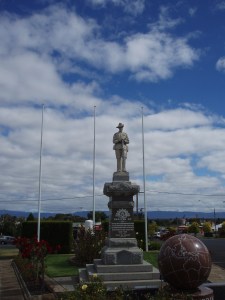
The War Memorial in the Victorian country town of Stawell Photo by Clare Rhoden
PHIL: OK, this may get deep. Working in places like the London Natural History Museum made me confront the lack of history I feel connected to. Not only am I am Australian – so part of one of the youngest nations on the planet – but I’m also from Canberra – arguably the world’s youngest city/capital. Certainly, our country is old, and the indigenous have some serious history, but in many ways, I feel that’s not my story to tell.
I collect stories, and many of these I find in strange locations, meaning they are often unreported. This has led me to creating a new history for Australia for a podcast I’m about to release … and it will all be bizarre Australian history that I’m certain many have never heard about, and all real. A samurai invasion of Australia decades before Cook arrived, the Fall of the Roman Empire leading to the Dutch landing in Western Australia … Napoleon sending an invasion fleet to Botany Bay … all true.
All of this has led me to understand – as many of us do – that our identity as Australians really did begin with Gallipoli. It’s when we first started to think of US and not THEM. The First World War is our American and French Revolution, our Civil War – it’s the conflict that forged us into the nation we know today, I mean, even the word ANZAC has become something for more than its original meaning, its something sacred.
VC Corner on the Western Front Photo by Clare Rhoden
Do you think that WWI still has lessons for us today?
PHIL: HELL yes. I believe statics show that, by population, no Allied nation lost more in the Great War than Australia. Similarly, no nation (that wasn’t physically part of the battle – like France) is still as affected by these losses as Australia.
Drive through many rural towns today in Australia and you’ll see a large monument in the town square noting their losses. The monument is often full of men with the same last name. Entire generations from these towns joined up and were often buried together in some field overseas.
These towns never truly recovered from their losses and rural Australia still feels underpopulated.
I feel this has all left something of an emotional national scar. One way we have been dealing with the great loss is the way we reverently look on those who served.
I feel what other nations can learn by this is perhaps the way we use the past, but we are not tied to it. Mateship is part of our national identity, but rather than let us restrict who we include into this circle, we try tp be inclusive.
This plaque at Villers Bretonneux commemorates the actions of Australian soldiers in re-taking the village from the Germans on Anzac Day, 1918 (photo by Clare Rhoden)
I think our natural outlook towards others, which is usually friendly, is why Australians worldwide are beloved.
Very interesting reflections, thanks Phil.
Now a bit about you! If you were stuck on a desert island
– or maybe in lockdown LOL –
what five books would you want with you?
PHIL: Ouch … only five … actually, challenge accepted.
The Black Company by Glen Cook. I love this series and it’s been a massive influence on me. The way Cook uses a bare-bones way of writing his stories is something I really have taken form heart. Don’t waste your time getting your characters from A to B – just get them there and move on with your story. I also just love his characters and the entire story line … this leads me to
Old Tin Sorrows by Glen Cook. This book and this entire series is da’ bomb. It’s also part of the inspiration for my first novel, Brotherhood of the Dragon. The books are about a fantasy hard-boiled detective called Garrett. I recall reading ‘Old Tin Sorrows’ when it suddenly struck me that many of the plot points were from Raymond Chandler’s The Big Sleep. In fact, the entire series is also heavily influenced by Rex Stout’s Nero Wolfe books, so I decided I wanted to join in the fun and also use these mechanics in Brotherhood.See if you can spot them? Golgotha also has similar influences – most notably the Third Man with Orson Welles.
Cetaganda/A Civil Campaign by Lois McMaster Bujold Ok, I may be cheating here, but let me explain. The Vorkosigan saga is one of the greatest novel series ever put to paper (and not just Sci-fi, but all series). Each one takes on a different theme. Cetagandais pure political/detective thriller. There are plots within plots and action and intrigue and red herrings and Mile Vorkosigan mentally pulling it all apart and finding the truth. Great stuff. The next book though is a romance/political thriller with plots within plots and intrigue and red herrings and Miles fumbling his way to asking the lady he loves to marry him. It’s the funniest book I have ever read and pure genius. I’ll also cheat here and suggest you get the audiobooks. Both of these I listen to at least once a year.
Moneyball: The Art of Winning an Unfair Game by Michael Lewis Possibly the most influential book on this list. Moneyball is about baseball statistics…and yet it’s so much more. The lesson it teaches is anything can be interesting if you find the right angle. Moneyball is about how to win when you’re losing, how to change tac when you realise you are going in the wrong direction, how to create something from nothing, how to make a weakness a strength and how to tell just a great freakin story. You can watch the movie – its great too – but honestly, read the book – especially if you are interested in facts more than fiction – you simply won’t regret it!
The Gilded Dinosaur by Mark JaffeThe history of palaeontology bookended by the greatest battle in science – the intellectual war between ED Cope and O C Marsh. Dinosaurs, palaeontology, cowboys, train robberies, explorers, nation building, the Smithsonian, political intrigue … and did I mention dinosaurs? What’s not to love?
You write across genres and have a wide range of amazing interests.
How do you juggle all of these with work and writing?
Do you have some time management or focus tips for us?
PHIL: Well, for one thing you will never suffer from writer’s block … you can always move onto another subject for a while and get refreshed/re-inspired.
That’s the cheat answer. To be helpful, I guess I would say work smart.
Research is fun but can create a serious freeze on your brain as you find yourself swamped by too much info. You will take notes – so many notes – well put them in Word! DO NOT USE A NOTEBOOK! Trust me, I’m a researcher and I love carrying around a notebook. The problem is, you end up with lots of notebooks – but do you ever look in them? And do you find what you’re looking for? So, work smart – put them in Word and then you can word search later for what you’re looking for.
Keep folders. You will be astonished how often you will be looking for some info, and you’ll find something that links into something you are working on. Don’t stop what you’re doing, cut/paste/save– take a screen shot or a photo – but save that info in the folder you have for that project and then get on with what you’re doing.
And this brings me to my most important point.
Finish your projects. Don’t get distracted, and I mean distracted by outside as well as internal influences. If you are working on a crime story, don’t start watching documentaries about the First World War, even if that’s something you are also going to work on. You’ll get distracted/inspired and lose your train of thought.
Stay on point – stay on theme – and you’ll get an astounding amount of work done.
Wow, Phil, thank you so much for your insightful answers. Wonderful!
And thanks in advance for sharing a chapter from Golgotha, which I know is wonderful.
Just one more to join our happy band of adventurers, Fitzhugh thought as they entered the Australian lines. They were immediately joined by several large men wearing the quintessential slouch hats the antipodean troopers favoured.
These men referred to themselves as ‘six-bob-a-day tourists’, referencing their daily wage, and their service meant the Australian government and senior commanders treated them with more respect than other nations treated their own men. The most obvious example was that no Digger could face a firing squad for any offence without the permission of the Australian government, and that permission was never forthcoming, despite the pleas of generals like Douglas Haig.
Golgotha by Phil Hore: a WWI trench murder mystery
Soldiers being soldiers, the Australian servicemen took full advantage of this leniency by rarely saluting their officers and hardly ever answering with the proper use of rank. Instead, the Aussies called their commanders by their first name, never wore their uniforms in the ‘correct’ by-the-book-way, nor took part in much of the silliness that soldiers from other nations had to endure.
Fitzhugh knew full well the reputation of these men, both on and — in this case — importantly off the battlefield.
At one point, the unruly Diggers had found themselves located in the lines near the 10th Royal Fusiliers, and here they became concerned for their fellow soldiers when the Fusiliers commander ordered them to parade every morning. The very English and newly minted colonel had decided he would have his men march a full-dress parade, with spit-and-polish uniforms, during their morning mounting of the guard. This was all done as the unit’s brass band played a merry ditty for the Fusiliers to march back and forth under the braying vigilance of Sergeant-Major Thomas Rowbotham. A lifelong military NCO, Rowbotham agreed with his colonel that strict discipline within the ranks was the only way to go.
Amid the mud, carnage, and death on the Western Front, the Diggers watched these parades with growing incredulity. Stationed next to each other, the two units inevitably began mixing and the Aussies eventually had to ask their British comrades if they enjoyed all that marching and dressing up.
‘Not on your life!’ replied one of the Fusiliers.
Another jumped in. ‘We have to do the parade during our downtime. Even at rest, we’re busy polishing buttons and boots, all so our bloody officers can feel like they’re leading proper soldiers.’
One burly Australian grinned an evil grin at his new friends and, slapping the much smaller man on the back warmly, said, ‘Right-o, cobber, we’ll fix that for you.’
The next day, Sergeant-Major Rowbotham called his men into parade. The Fusiliers all dutifully filed in and the regimental band lifted their instruments, awaiting the Sergeant-Major’s signal. As Rowbotham lifted then dropped his arm to signal them to play, he was greeted by a cacophony of what some would later recount fondly as noise.
Marching up and down behind Rowbotham were the Australians, playing what could be kindly described as instruments. Most were rusty and showed the signs of a hard life, but none of this mattered as the Aussies couldn’t play them anyway. Instead, they just blew and banged as hard and loud as they could, to drown out Rowbotham’s orders. Each time the makeshift orchestra began to wane, and the Sergeant-Major tried to regain control of the situation, the Australians began playing again with even greater vigour. After nearly half an hour of this, the Sergeant-Major, in utter defeat, finally strode away in a huff and the Fusiliers were never called to parade again. The Australian trench band was always watching and ready to start up their battlefield symphony if they did.
‘Can I help you, gentlemen?’ one of the Australian soldiers asked.
‘No, thank you, just passing through,’ Fitzhugh answered as Andrews manoeuvred to place himself between the two men.
‘What have we here? It seems the officer is taking his dog out for a walk,’ another Aussie said. ‘Down there, Fido. Sit!’
Another of the soldiers asked, ‘Does your dog do any tricks?’
‘Sergeant,’ Fitzhugh cautioned, as Andrews took a threatening step toward the jokester.
‘Nice leash, puppy,’ the Australian said, indicating Fitzhugh with a nod of his hat.
‘Actually, perhaps you men can help me?’ the captain asked, his tone remaining warm.
‘What’re you after? A German flag? A helmet? We got lots of souvenirs to impress the folks at home. You can even say you collected them yourself, you big brave British soldier you.’
‘Even have an officer’s uniform. It’s still a little bloody from where Barney here gutted the bloke.’
Ignoring the clear threat, and taking the statement as a joke, thus passing the test the Australians had laid out, Fitzhugh replied sincerely, ‘No, no, do not offer me any of your baubles. I was hoping for some information. Do any of you men know Sergeant Hank Ash?’
‘Now what would a proper British officer like you want with Mr Ash?’ the soldier called Barney asked with a heavy Irish accent.
Both Fitzhugh and Andrews caught the sudden change in attitude. All had gone from casual, fun-loving jokesters to rigid and aggressively hard.
‘I’m here to try to save his neck!’
***
The newly demoted Private Hank Ash sat in his cell, his sleeves sporting discoloured sections where his sergeant chevrons used to be. Two armed English guards stood directly outside his cell, situated in a small outbuilding of the farm that was being used as a temporary prison behind the Australian lines. Outside stood more guards, while the farmhouse itself had been converted into a makeshift barracks.
Through a small field that should have been full of feeding chickens and a garden, but now housed a small latrine on one side and a smouldering fire on the other, Fitzhugh, Andrews, and their Australian retinue marched. Approaching the farmhouse door, Fitzhugh took off his cap and stepped inside, returning the salute of the guards as he did. His retinue moved on to the barn, calling out to their mates inside.
Walking into the prison’s makeshift office, Fitzhugh found an English major with a Douglas Fairbanks moustache taking a cup of tea from a brawny NCO.
‘No milk in mine, Corporal,’ he said, inviting himself to sit down at the major’s desk.
The corporal looked from one officer to the other, not sure if he should be turfing the intruder out and hoping for a cue from his commander as to what to do. The major flicked a look at the door and the man left.
‘Perhaps a little sugar if you have it, Corporal,’ Fitzhugh called after the departing man, ‘and a bikkie.’
‘How can I help you, Captain…?’
‘Fitzhugh, Major Preston.’
‘It would seem you have me at a disadvantage, Captain Fitzhugh.’
‘So it would seem, Major,’ Fitzhugh replied, mirroring the senior officer’s reference to his rank to let the man know he knew that trick and wasn’t about to be cowed by an officer just because he had a little more brass on his shoulders.
‘How can I help you?’
‘Well, sir, I’m here to take Sergeant Ash off your hands.’
‘Very funny, Captain. Now, why are you really here?’
Rather than repeat himself, Fitzhugh removed a letter from his breast pocket, unfolded it, then slowly and deliberately smoothed its creases before handing the paper over. As the officer read the letter, Fitzhugh could tell when he read the name scrawled on the bottom of the page, as his eyes suddenly grew very wide.
‘This is signed by Haig.’
‘General Haig.’ Fitzhugh smiled warmly, continuing their game a little longer.
‘Are you sure it’s Ash you want?’
‘I have been hearing that question a lot recently. Absolutely it is Ash I want.’
‘And you know what he did?’
‘Let me see, he was wounded at Gallipoli after showing enormous courage, and has been serving very bravely here since….’
‘Since he broke a lieutenant’s jaw–’
‘From what I heard, the lieutenant deserved a broken jaw.’
‘He was still a superior officer,’ Preston said.
‘Senior officer, Major. I’m not too sure how “superior” the man was. Let’s not be conjuring facts we have no actual evidence. Personally, I refuse to condemn a man standing against a practice more in tune with the brutality of the inquisition. Now, I believe Sergeant Ash is yet to be convicted of this crime?’
‘That’s true.’
‘May I ask why it’s taken so long to court-martial a man who struck an officer? The official report is frustratingly vague on why he has missed his last three court appearances. For that matter, how are you still in charge, having failed to get your prisoner to his hearing…if I may be so bold as to ask?’
‘Very simple.’ The major opened his hands, as though displaying something on the table before them. ‘My predecessor was a total and utter moron.’
Biting off a laugh from the unexpected comment, Fitzhugh regained control of himself. ‘Care to elaborate, sir?’
‘The buffoon arrested Ash and placed him in this stockade, a stockade, I’d like to point out, that is surrounded by the entire 1st Australian Division.’
‘Gotcha,’ Fitzhugh said, realisation striking.
‘Every time we have tried to move ‘Private’ Ash, those bloody Australians have intercepted us. It seems they are determined to make sure he never sees the inside of a courtroom, and their own officers are uninterested in doing anything to help clear our path.’
‘How are they stopping you?’
‘Well, you may have noticed the Aussies have men posted along every route into and out of this place, and they seem to be ready to move on a moment’s notice if they sense we are up to something. The first time we tried to take Ash to his court appearance, we found nearly a thousand men choking the road, doing the finest parade drill I have ever seen. Every time we tried to cut through them, some unseen voice would order a platoon to move into our way, and they would begin vigorously marching.’
No longer interested in hiding his mirth, Fitzhugh asked, ‘And the next time?’
‘We tried to sneak him out after making sure the time of his hearing was never announced. Somehow, when we went to move him, we suddenly had hundreds of Australian soldiers pushing into the little courtyard out there. They managed to never disobey an order, as the ones who could hear us became hopelessly trapped by the men at the rear continuously pushing forward. It took hours to disentangle everyone, and by then the court had dispersed for the day.’
‘So, I assume you next tried to bring the court here?’
‘We did, and here’s why I really hate those fucking antipodeans.’ The major almost spat. ‘Clearly, they have either befriended or bribed some of my guards, as no sooner did I have it planned for the court to visit us, the Australians struck again.’
‘Struck?’
‘Well, of course, I have no proof of this, but I find it suspicious that the horses the court were going to use to get here disappeared, and of course, they refused to walk all the way, and vehicles would never have made the journey through the trenches.’
‘The Australians stole the horses?’ Fitzhugh asked, grinning.
‘They steal everything not tied down, bloody convicts.’ Sensing he may have said too much, the warden backpedalled. ‘Well, as I said, there’s no proof. Though the Aussies did seem to eat well for the next few days. They had themselves a grand barbeque. They even invited us for a meal.’
Fitzhugh gasped and looked toward the heavens. ‘Thank God!’
‘Captain?’ the major asked, a little confused.
‘Sorry, sir, I was just thanking the Almighty that they’re on our side, because I wouldn’t want to be facing the bastards if they ever got really angry at us.’
‘I hadn’t thought about that,’ the warden said. ‘Thank God!’
Also, don’t forget that as a special for July, Golgotha is included in the Fromelles Anniversary Book Bundle from Odyssey Books – along with my novel The Stars in the Night, and Jim Ditchfield’s Nursing Fox. Something for everyone!
Fromelles Anniversary Book Bundle from Odyssey Books: three fascinating WWI stories from Australian authors
What is it that makes the Attack at Fromelles resonate with Australians?
Fromelles Anniversary Book Bundle from Odyssey Books: three fascinating WWI stories from Australian authors
July 19-20, 1916
The Battle of Fromelles was Australia’s first action on the Western Front. It was disastrous.
Arguably the worst 24 hours in Australian military history, there were over 5,500 Australian casualties.
Five hundred men were taken prisoner and almost 2,000 were killed.
In one night at Fromelles the Australian casualties
were equivalent to those in
the Boer, Korean and Vietnam Wars, combined.
The Fromelles Anniversary Book Bundle Special features three Australian novels of the war. Now available at these online stores for only $9.99. Grab your copy before the end of July!
This statue, titled “Cobbers” by Melbourne artist Peter Corlett was was installed in the Australian Memorial Park at Fromelles, France in 1998.
In the days after the battle rescuers recovered some 300 wounded from no-man’s land.
As one soldier carried a wounded companion from the field he heard a call for help.
Don’t forget me, cobber
The “Cobbers” statue in the Australian Memorial Park at Fromelles in France features Sergeant Simon Fraser from Western Victoria carrying a fallen comrade from the field.
Cobbers is a memorial to Australian service and sacrifice at the Battle of Fromelles. Fraser risked his life and a possible court martial when he returned to save a stricken soldier whose identity is unknown.